Anúncios
Have you ever wondered why scenes in New York and beyond shifted so quickly in recent seasons?
You saw it happen: institutions and artists teamed up to test bold formats, and audiences rewarded shows that put community voice first.
Events across Upper Manhattan combined theater, music, comedy, and dance into one living lab for fresh performance ideas.
Curators made inclusion the rule, and funders backed daring projects that blurred lines between creators and neighbors.
The result was a faster, clearer path for new work to reach people — premieres, commissions, and collaborations reshaped what success looked like.
Anúncios
What’s Driving Dance Festival Evolution Right Now
You’re watching three clear forces push programming toward bolder work: inclusion that guides curators, hybrid performance forms, and steady institutional backing.
Inclusion and community are now the backbone of choices. Festivals prioritized cultural breadth so audiences and artists met on common ground, not at the margins. Events became sites for dialogue and shared learning before and after shows.
Interdisciplinary approaches
Putting dance beside music, theater, and comedy unlocked new dramaturgies and sonic textures. You saw pieces like Bill T. Jones’s “Curriculum II” rethink hierarchy and present performers in fresh frames.
Anúncios
Funding and institutional backing
Support from bodies such as the New York State Council on the Arts and programmatic seasons gave artists runway to test ideas. ADF’s seasons — with 13 commissions and nine world premieres in 2023 — show how reliable backing accelerates experimentation.
- You experienced community-building as a design principle that shaped programming.
- Artists used movement research to probe identity and power in real time.
- Events became iterative platforms where feedback tightened creative cycles.
For more on how these trends unfolded in practice, see an evolution competition piece that traces similar shifts.
New York as a Microcosm: How NYC Festivals Signal the Shift
Upper Manhattan’s September calendar showed you a compact map of change. Small stages linked local artists, programmers, and audiences so you could follow a narrative across dates. That concentrated approach made it easy to see what works in practice.
CWP Evolution Festival’s 2025 programming across Upper Manhattan
The CWP EVOLUTION FESTIVAL ran across neighborhood venues from Sept–Oct 2025. You saw NYC-based artists present varied work on specific dates, including Cat Rave (Sept 5), Fit for Freedom (Sept 9), Elizabeth (Sept 10), and Maurine and Maurice Show (Sept 12).
Later bills mixed Celtic Odyssey (Sept 19) with multimedia pieces like Pathways & Architecture (Sept 29) and The Tearing Blue of the Sky (Oct 2). This stitched programming let you compare tradition and experiment within one local arc.
NY International Dance Festival: world cultures, Hispanic Heritage Month, and artist-forward leadership
On Sept 20, the NY International Dance Festival at Manhattan Movement & Arts Center brought a true world roster. You experienced Ukrainian, Georgian, Hungarian, Flamenco, Bharatanatyam, Odissi, Bollywood, Brazilian samba, Argentine Tango, West African, Chinese, and Latin forms with live music and song.
Artist-forward leadership mattered: Artistic Director Brigid Le Minez worked with Dance Masters Quimen Sanchez and Nicole Mandy to center technique and cultural specificity. Ensembles like American Liberty Ballet and Georgian “Elva” showed how local networks grow visibility.
- You saw Hispanic Heritage Month used as an organizing principle that honored artists and audiences.
- You tracked how weekly scheduling created a steady pulse for the community to follow.
- The combined presence of live music and varied ensembles made each program feel like a cultural conversation.
From Stage to Society: Modern Dance Trends Reshaping Festivals Across the U.S.
Across stages and lobbies, modern companies tested how movement could carry civic ideas into daily life. At ADF, you saw this shift in bold work that made physical choices mean something public and political.
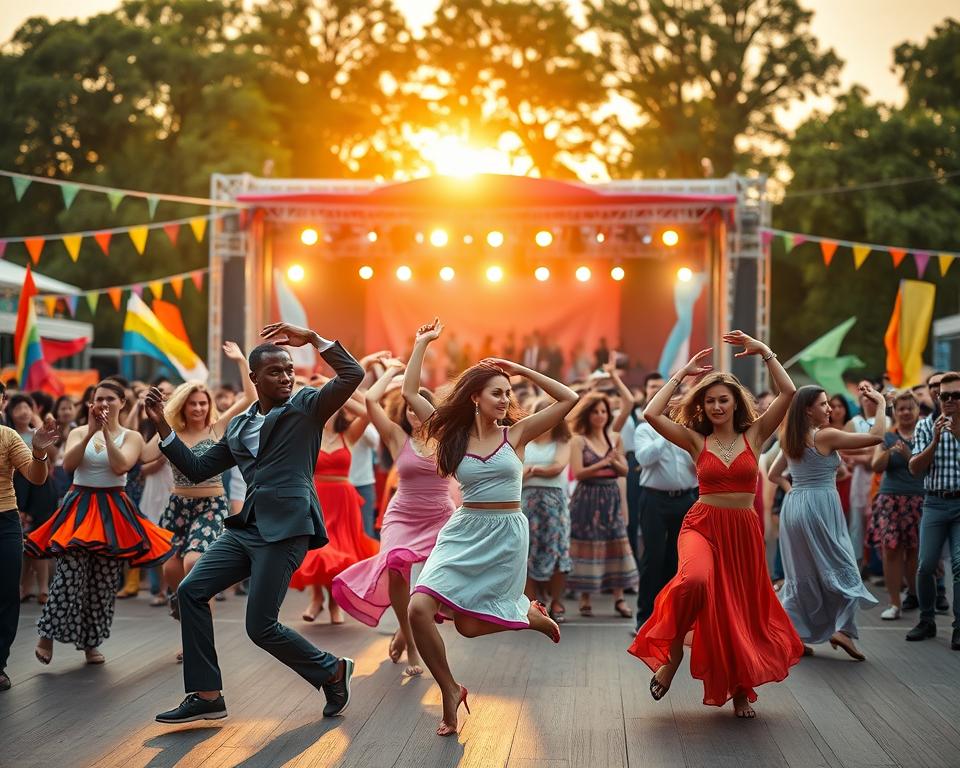
Curriculum II by Bill T. Jones/Arnie Zane opened with bodies as celestial figures, upending tall/short assumptions and who lifts whom. Michael Klien’s Parliament at Duke stretched practice into three hours of silent, music-free social choreography that trained attention and empathy.
- You watched technique become a toolkit, letting creators deconstruct form and ask new questions.
- Movement freedom centered the program: partnering, costuming, and timing rewrote authority onstage.
- Inclusion lived in casting and partnering so belonging registered in the body as much as the program notes.
- Commissions and nine world premieres at ADF gave artists room to iterate and send work out to the wider world.
The result was a wider idea of success: your measure of a performance became how fully it invited you into its logic and left you changed.
Conclusion
You saw how New York programs turned local ideas into wider practice. Neighborhood events and artist-led projects made clear that curation can be both locally rooted and globally aware.
When leaders trusted artists, and funders offered steady support, risk became learning. Music-forward collaborations and cross-disciplinary frames made concerts feel porous to the world outside the theater.
That mix — strong leadership, civic backing, and artist trust — meant you left seasons feeling part of a community, not just a night out. Keep looking for programs where inclusion and invention shape the experience, and you’ll find a richer, more compelling dance festival season ahead.